Can I split a semaglutide dose into two injections?
You can split a weekly semaglutide dose across two injections, but the pharmacokinetics don't change meaningfully and side effects rarely improve. Here's why.
Updated May 9, 2026 · 3 min read
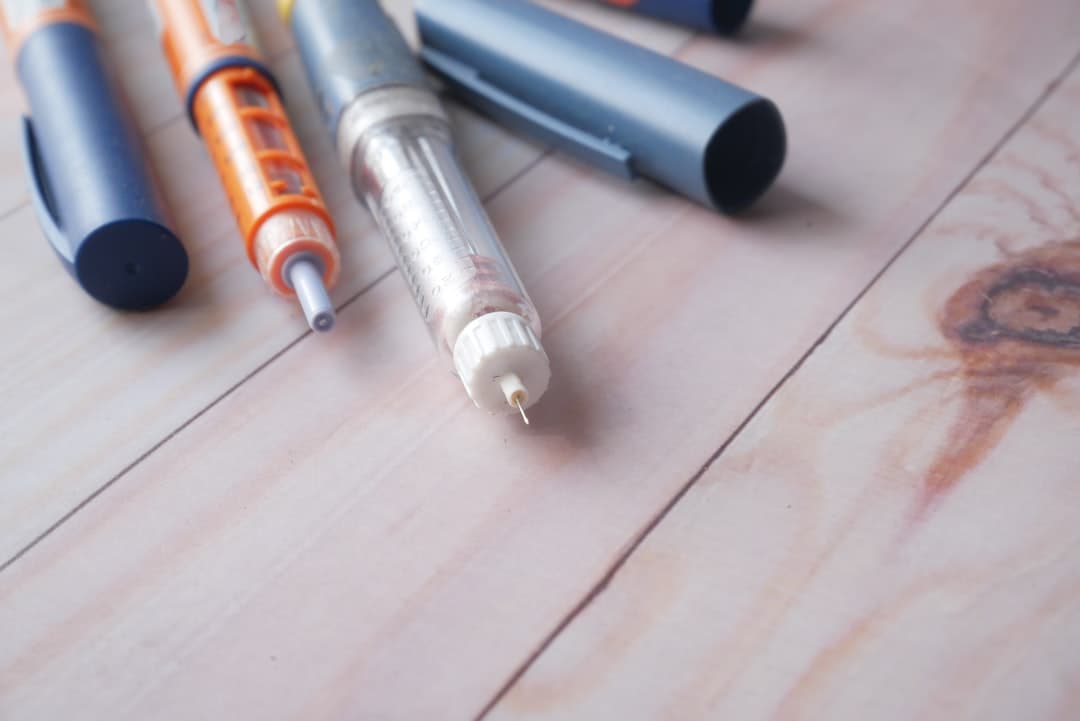
You can physically split a weekly semaglutide dose into two smaller injections — for example, half on Monday and half on Thursday — but it almost never does what people hope it does. Semaglutide's half-life is about 7 days, so blood levels are already smooth across the week from a single injection. Splitting doesn't reliably reduce nausea, doesn't improve weight loss, and doubles your injection burden. The one place it can make sense is during titration with compounded semaglutide and provider guidance.
The pharmacokinetic reality
A weekly injection of semaglutide produces a near-flat steady-state concentration after about 4–5 weeks of dosing. The peak-to-trough swing within a single week is modest — far less than what you'd see from a daily drug.
When you split a 1.0 mg weekly dose into two 0.5 mg injections 3–4 days apart:
- Average concentration: essentially unchanged
- Peak concentration: slightly lower
- Trough concentration: slightly higher
- Net effect on receptors: indistinguishable from the unsplit dose for most people
The math is not "half a dose hits half as hard for half as long." It's "you're injecting into a reservoir that's already 75% full from last week's dose."
Why people try splitting (and what usually happens)
Hoped-for benefit: less nausea. Reality: nausea correlates more with peak concentration after a dose increase than with the steady-state level. Splitting a stable weekly dose rarely changes the post-injection nausea pattern. The big nausea windows happen at week 5, week 9, and week 13 — when you titrate up — and splitting does nothing for those.
Hoped-for benefit: smoother appetite control. Reality: most people on a steady weekly dose already have smooth appetite control. The "food noise" return some users describe in days 6–7 of a stretched dose isn't fixed by splitting — it's fixed by not stretching.
Hoped-for benefit: easier titration. This is the one scenario with some logic. Going from 0.25 mg to 0.5 mg is a 100% jump. Splitting briefly into 0.25 mg twice-weekly while your gut adjusts is a workaround some compounded users employ — but it should be cleared with the prescriber, and most clinicians prefer holding at the lower dose for an extra few weeks instead.
When splitting is reasonable
- Compounded semaglutide users with provider sign-off during a difficult titration step
- People with severe injection-site reactions at higher volumes — splitting reduces volume per site
- Microdosing protocols at very low doses (e.g., 0.05 mg twice weekly) that some clinicians explore for tolerability — this is off-label and not standard
When splitting is a bad idea
- You're on a brand pen. The pen is calibrated for a single dose. Splitting requires drawing it out, which voids sterility assumptions and is harder than it sounds.
- You're hoping it reduces side effects from a dose you can't tolerate. The right move is a slower titration or a hold at the previous dose, not a split.
- You're trying to "stretch" the medication. Splitting doesn't extend supply — it's the same total milligrams.
How to think about it
Semaglutide was engineered to be once-weekly. The whole point of the molecular design — adding a fatty-acid chain that binds to serum albumin — was to extend the half-life so you wouldn't need multiple injections. Splitting fights against the drug's main feature.
If a weekly injection isn't working for you in some specific way, the better questions are:
- Is the dose right? Step down or hold.
- Is the timing right? Try a different day of the week.
- Is the site right? Rotate; some sites absorb differently.
- Are side effects manageable? Dietary tweaks (small bland meals, no greasy food after injection) help more than splitting.